Soil is the foundation of life, it also purifies and stores water, protects us from flooding, regulates the Earth’s temperature, and provides a home for many small organisms. Moreover, recent research suggests that it can contribute to the fight against climate change.
After completing her undergraduate studies at UC Davis in environmental science, Jesse Landesman pursued a master’s degree in UCSB’s Geography department, studying what drives sediment accumulation and carbon sequestration in a restored wetland system. This research project was devised by her advisor, Dr. Jennifer King, and Dr. Lisa Stratton for the Cheadle Center for Biodiversity and Ecological Restoration (CCBER) with the help of consultants from the Environmental Science Associates (ESA) in 2016.

Dubbed the North Campus Open Space Restoration Project, it aimed to restore native habitats and ecosystems in the North Campus Open Space (NCOS), as it had previously been a golf course. Plots of feldspar, a chalky mineral abundant in the earth’s crust, were dug at the Coal Oil Point Reserve (COPR) and at NCOS. The plots were left undisturbed for five years to allow sediment to accumulate on top of the feldspar. This enabled them to assess the success of their restoration efforts by measuring carbon concentration and vegetation inputs, as higher levels in surface and subsurface soils indicate healthier soil.
To collect and analyze the data, Jesse worked with a team of students, including two who incorporated the dataset into their undergraduate senior theses. The team assessed soil conditions through multiple indicators, including vegetation sampling, since plant community composition and overall vegetation health can reflect underlying soil properties. They also quantified sediment accumulation over a five-year period and measured soil carbon content to better understand changes in soil development
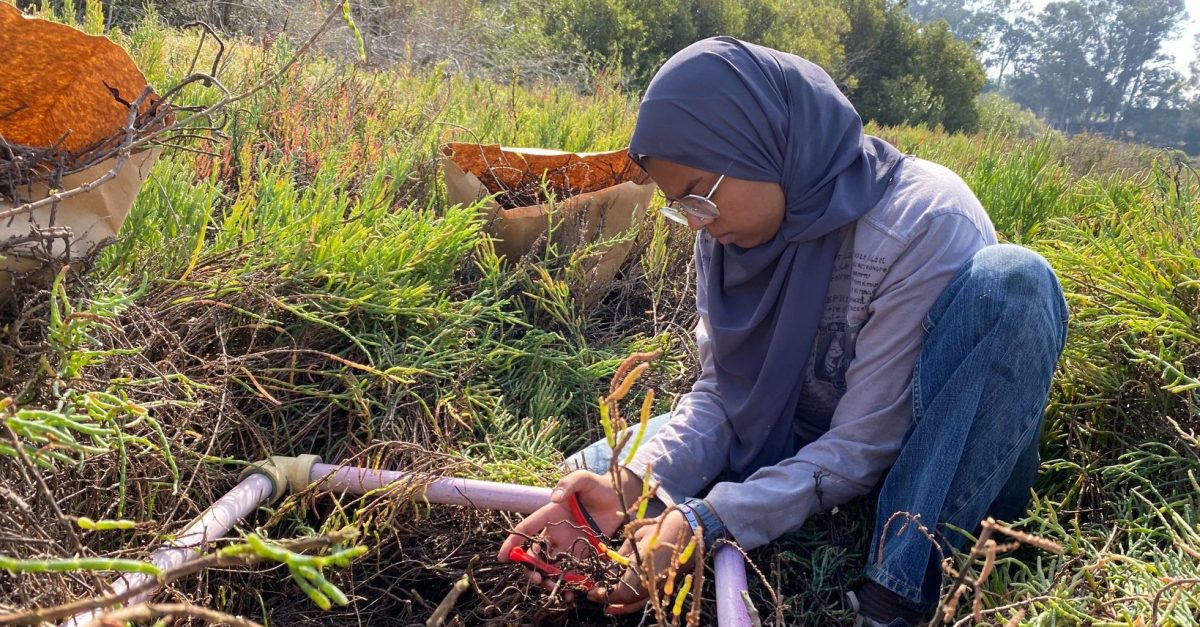
and ecosystem function. An obstacle they faced was when water penetrated the plots, as it carried the feldspar away, leaving nothing with which to measure the amount of accumulated soil.
When she returns to UCSB, Jesse hopes to continue working with students and identify new ways to support farmers, working alongside them and making her research accessible to them.
To learn more about Jesse Landesman, you can visit her website for her FFAR Fellowship (Foundation for Food and Agriculture Research). You can also read about her avocado research here.